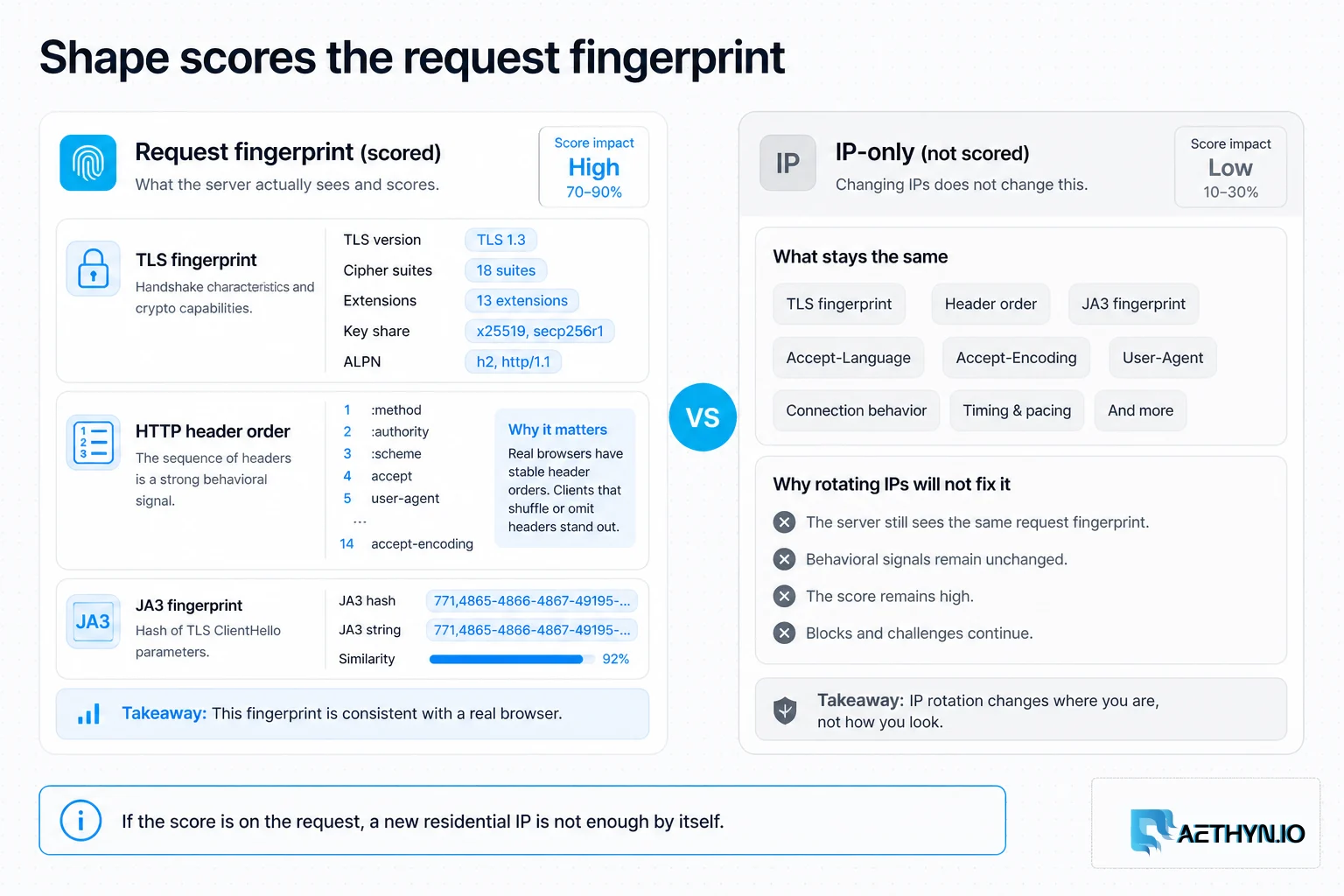
Which defense layers are scoring your request
Connector / edge
Bot Defense rides XC, BIG-IP, CloudFront, Cloudflare, Commerce Cloud, Adobe Commerce, or custom connectors — tech detectors often stop at the CDN.
JS instrumentation
Script injection points (after head/title/before script) enable telemetry collection on configured routes.
Telemetry attach
Single-use header sets or POST body telemetry on protected requests; replays are invalid by design on mobile guidance.
Endpoint policy
Methods include GET(Document), GET(XHR/Fetch), POST, PUT, PATCH, DELETE, HEAD, OPTIONS, TRACE — scoped per path.
Mitigation
Continue/flag vs block/redirect/transform/(drop). Transform yields “successful” HTTP with useless payloads.
IP reputation
Residential helps ASN/velocity only; missing telemetry is not fixed by rotation.
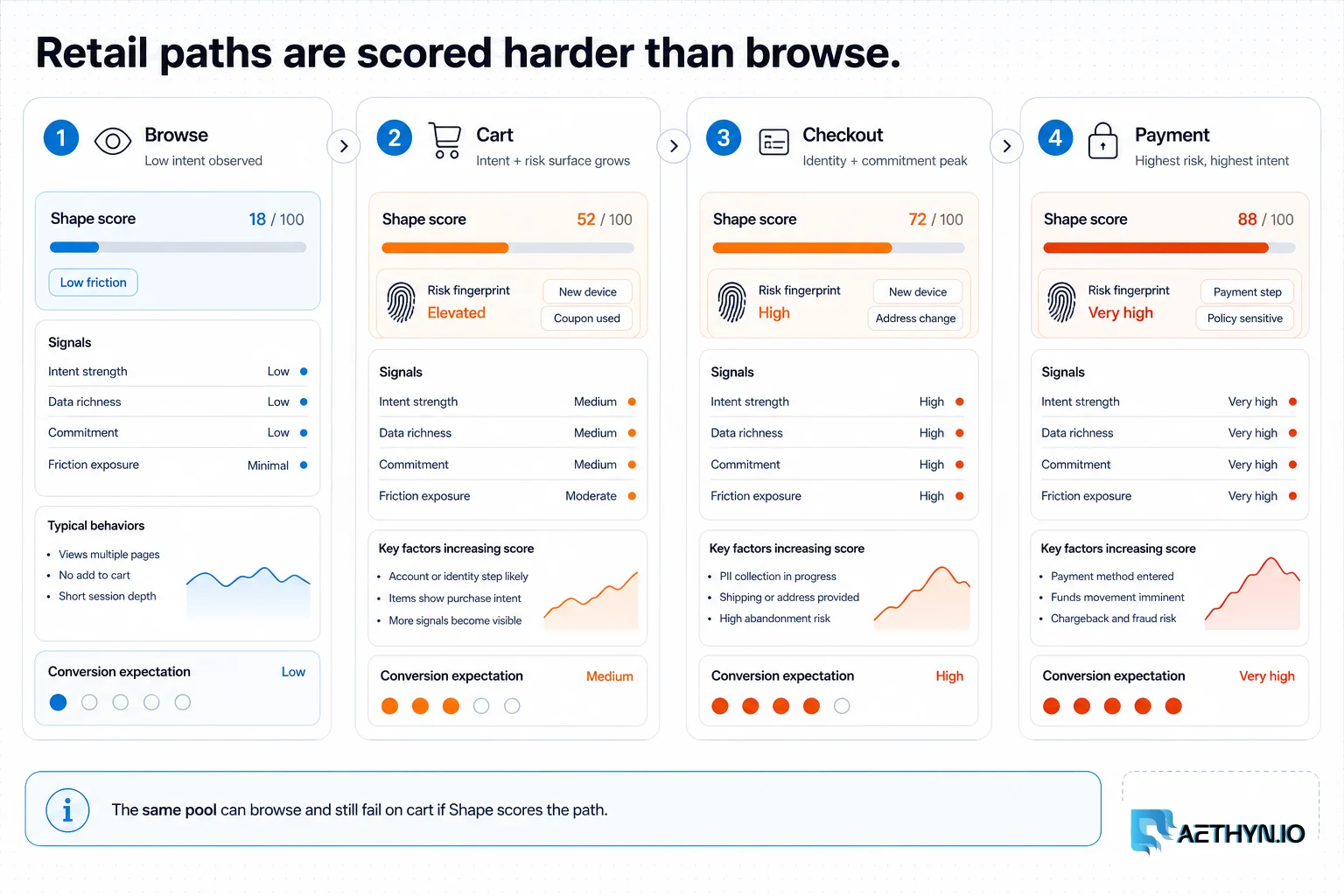
How to implement this with residential proxies
- 1
Map asymmetry before naming the vendor
Hit the document URL and the failing XHR/POST with the same client. Shape-class deployments often protect methods differently — a 200 homepage never falsifies Bot Defense on /api/availability.
- 2
Eliminate lookalike cookies
TS + hex → BIG-IP ASM (length varied by version). BIGipServer* → LTM persistence. MRHSession/F5_ST family → APM. reese84 → Imperva Distil-lineage cookie name, not Shape. x-acf-sensor-data → Akamai mobile sensor. None of these equal Bot Defense.
- 3
Three-way curl on the failing method
Plain, Chrome-UA, residential — against the protected endpoint, not only /. Expect missing telemetry to look similar across exits when Transform/Block ignores IP.
bashEP='https://TARGET/api/availability' UA='Mozilla/5.0 (Windows NT 10.0; Win64; x64) AppleWebKit/537.36 (KHTML, like Gecko) Chrome/128.0.0.0 Safari/537.36' PX='http://aethyn-XXXXX-country-us-isp-comcast:PASSWORD@proxy.aethyn.io:5499' for label in plain ua res; do echo "=== $label ===" case $label in plain) curl -sS -D - -o /tmp/sh.body "$EP" ;; ua) curl -sS -D - -o /tmp/sh.body "$EP" -A "$UA" ;; res) curl -sS -D - -o /tmp/sh.body "$EP" -A "$UA" -x "$PX" ;; esac | grep -iE 'HTTP/|set-cookie:|content-type|x-volterra-location' python - <<'PY' from pathlib import Path b=Path('/tmp/sh.body').read_bytes() print('bytes', len(b), 'head', b[:120]) PY done - 4
Read F5-documented behaviours, not unverified blog claims
Prefer primary facts: telemetry in headers or POST body; Telemetry Header Prefix as a console field; interstitial on GET(Document) transparent to users and typically once per session; ISTL as an F5 scraping-endpoint configuration name without a confirmed expansion. Avoid publishing single-capture body strings as universal fingerprints.
- 5
Remediate honestly
If residential changes the failing endpoint, keep ISP targeting. If not, you need an instrumented browser path that can attach telemetry under your compliance rules — still not a CAPTCHA-solving guide.
What goes wrong when this scraper fails
Retail collectors scrape the PDP fine, then availability or add-to-cart calls return opaque JS or empty data with 200. Wappalyzer shows Cloudflare or BigIP and the team chases the wrong product. Shape-class failures are silent in response space and loud in endpoint asymmetry.
Why this failure mode happens
F5 documents that Bot Defense collects browser telemetry and attaches it on protected requests, often after an interstitial on GET(Document). Continue/flag mode can let traffic pass while logging — collectors look healthy until mitigation flips. Because telemetry is client-generated, curl without the JS path never participates correctly, and rotating IPs cannot mint tokens.
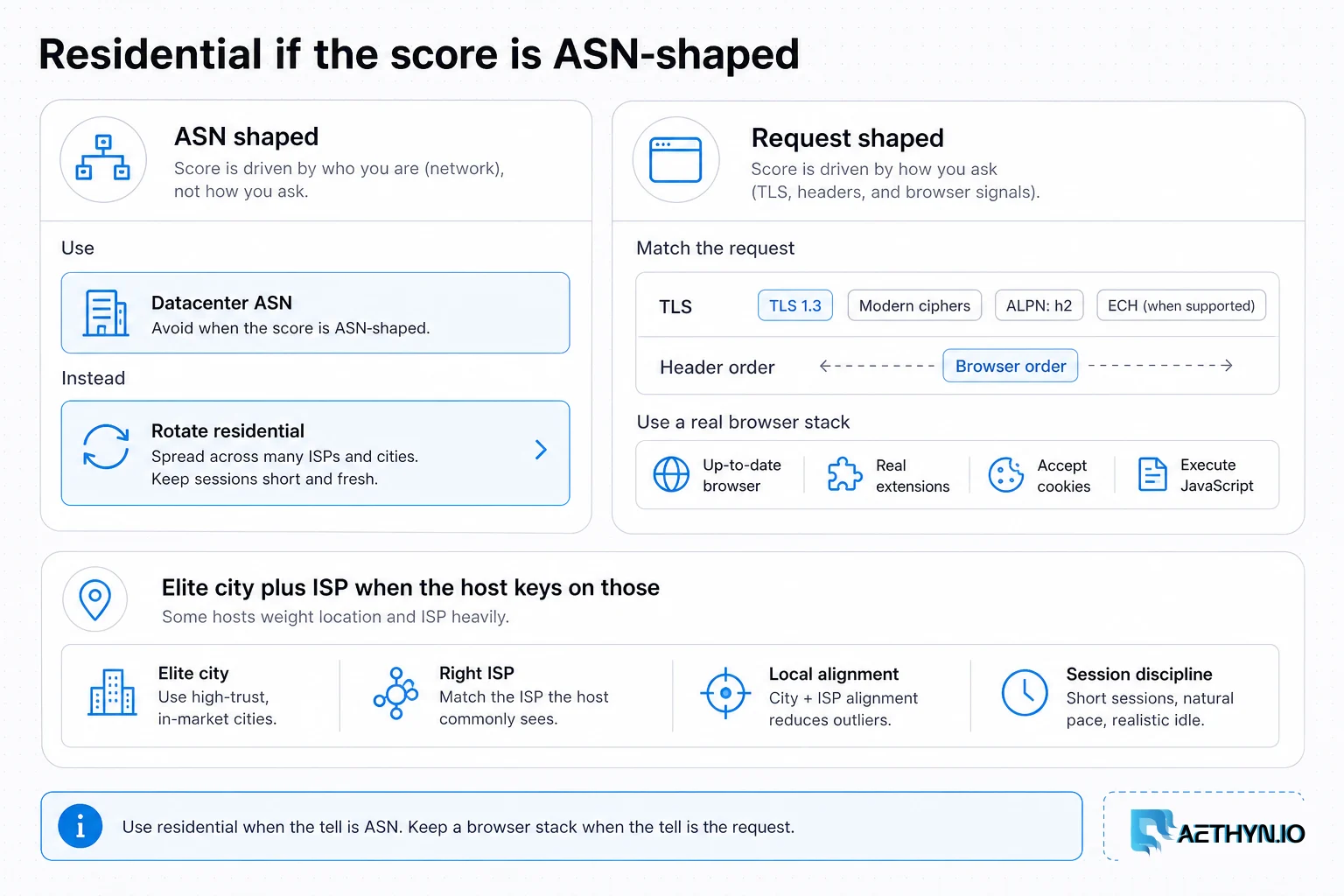
How Aethyn residential proxies help here
Use ISP-targeted Elite sticky sessions when retail bots are scored per carrier, and keep three-way proof that IP is actually implicated before scaling concurrency.
- Elite HTTP 5499 + ISP suffixes for carrier-sensitive retail
- Sticky lifetimes for session-carrying browser flows
- Premium 2099 for asymmetry surveys
- SOCKS5 3499 for Playwright
- Explicit non-claim: proxy ≠ Shape telemetry
Common questions about this scraper problem
How do I detect F5 Shape from a response?
Where does the Shape fingerprint live?
Are BIGipServer or TS cookies Shape?
Does rotating residential proxies bypass Shape?
Aethyn ports for retail asymmetry tests?
CAPTCHA or step-up solving?
Best practices that keep scrapers reliable
- Test the failing method, not the marketing homepage
- Disqualify BIG-IP/Imperva/Akamai lookalikes
- Prefer F5 primary docs over detector regex blogs
- Assume Continue/flag can precede hard mitigation
- Public-data collection only
Common mistakes that burn proxy budget
- TS* ⇒ Shape
- reese84 ⇒ Shape
- Homepage-only probes
- Infinite IP rotation on transform 200s
- Inventing global telemetry header names