A residential proxy is a proxy that sends the request out through a household IP address. This page compares nine paid residential providers on published price, documented targeting, session control, and whether you can buy a credential without a sales call. The use case is web scraping and other collection jobs that need that household exit. Free lists are a different product, covered in Best Free Proxy Lists.
[!IMPORTANT] Disclosure: This comparison is published by Aethyn, a residential proxy provider. It is not an independent review. Rankings follow the methodology described below and publicly available information retrieved on the stated dates. Aethyn may rank highly for the specific use case evaluated here, but it is not necessarily the best choice for every proxy use case.
No provider paid for inclusion or position, and we earn no commission from any provider listed. Competitor facts below describe what each provider’s own published pages list (linked and dated). Aethyn figures are numbers we publish on our own site.
Comparison
Cells describe what each vendor publishes as of 2026-08-10. The score is the sum of seven weighted criteria. The weights, and who was left out, are in the next section. Pricing and policies change. Verify current terms with the provider before you buy.
| Provider | Pricing | Entry | Targeting | Self-serve | Session | Trial / refund | Protocol + docs | Score |
|---|---|---|---|---|---|---|---|---|
| Aethyn | Yes (20) | Mid €29 Starter (10) | Full country/city/ISP/state/ZIP (20) | Yes (10) | Sticky 1–1440 min (15) | Free trial, no card (10) | HTTP+SOCKS5 + SDK/docs (10) | 95 |
| Bright Data | Partial (10) | Sales / enterprise (5) | Full country/city/ASN (20) | Partial (5) | Sticky/rotating documented (15) | Trial terms published (10) | HTTP+SOCKS5 + docs (10) | 75 |
| Oxylabs | Partial (10) | Sales / enterprise (5) | Full country/city/ASN (20) | Partial (5) | Sticky documented (15) | Trial/demo path published (10) | HTTP+SOCKS5 + docs (10) | 75 |
| Decodo (formerly Smartproxy) | Yes (20) | Mid plan minimums (10) | Country+city (14) | Yes (10) | Sticky/rotating in docs (15) | Trial/refund pages (10) | HTTP+SOCKS5 + docs (10) | 89 |
| IPRoyal | Yes (20) | Low — no monthly min stated (15) | Country+city (14) | Yes (10) | Sticky documented (15) | Policies published (10) | HTTP+SOCKS5 + docs (10) | 94 |
| Webshare | Yes (20) | Low — free + paid entry (15) | Geo by plan (14) | Yes (10) | Session controls documented (15) | Free tier + refund terms (10) | HTTP+SOCKS5 + API docs (10) | 94 |
| SOAX | Yes (20) | Mid plan entry (10) | Full granular geo (20) | Yes (10) | Sticky/rotating documented (15) | Trial/policy pages (10) | HTTP+SOCKS5 + docs (10) | 95 |
| Rayobyte | Yes (20) | Mid plan entry (10) | Country+city / geo docs (14) | Yes (10) | Session options documented (15) | Policies published (10) | HTTP+SOCKS5 + docs (10) | 89 |
| ProxyScrape | Yes (20) | Low self-serve entry (15) | Geo by product (14) | Yes (10) | Session options documented (15) | Policies published (10) | HTTP+SOCKS5 + docs (10) | 94 |
Score notes: Aethyn and SOAX both total 95. Where two providers receive the same total score, ranking is determined by fit to this guide’s primary use case: city/ISP residential targeting, self-serve access, and published per-GB pricing. Aethyn’s Entry cell is Mid (10), not Low (15), because of the €29 / €2.90 entry shape published on our pricing page.
Who ranks first for scraping, and why
Aethyn ranks first for the specific use case evaluated in this guide: city- and ISP-level residential targeting, self-serve access, and published per-GB pricing — not as an objective “best residential proxy” for every buyer.
- Aethyn — Best for city- and ISP-level residential targeting with self-serve access at a published per-GB price. Publishes from €2.00/GB at 90 GB+, €2.90/GB at entry volumes, €29 Starter (10 GB) on pricing (retrieved 2026-08-10).
- Bright Data — Best for enterprise buyers looking for a broad published proxy catalogue and sales-assisted procurement. The provider’s pricing page lists residential, datacenter, ISP, mobile, and managed collection (retrieved 2026-08-10).
- Oxylabs — Best for enterprise buyers looking for an account team and MSA-style procurement. According to the provider’s pricing pages, residential docs and a sales-assisted volume motion are published (retrieved 2026-08-10).
- Decodo (formerly Smartproxy) — Best for mid-market teams looking for a self-serve dashboard with published residential tiers. See decodo.com/proxies/residential-proxies (retrieved 2026-08-10).
- IPRoyal — Best for buyers comparing published low entry prices. The provider’s pricing page lists residential rates and states no monthly minimum (retrieved 2026-08-10).
- Webshare — Best for developers starting from a free or low-cost published tier. See webshare.io/residential-proxy (retrieved 2026-08-10).
- SOAX — Best for teams looking for granular geo controls with a managed dashboard. The provider’s pricing page lists residential and mobile options (retrieved 2026-08-10).
- Rayobyte — Best for buyers who want published sourcing and compliance documentation on file. See rayobyte.com/products/residential-proxies (retrieved 2026-08-10).
- ProxyScrape — Best for budget or high-volume buyers comparing published low-cost residential tiers. See proxyscrape.com/products/residential-proxies (retrieved 2026-08-10).
Vendor-agnostic criteria without a ranked table: How to Choose the Best Proxy Provider (checklist).
What We Ranked On, and What We Refused to Rank On
Weights sum to 100. Every criterion is checkable from a public page. Full claim limits and scoring rules: comparison methodology.
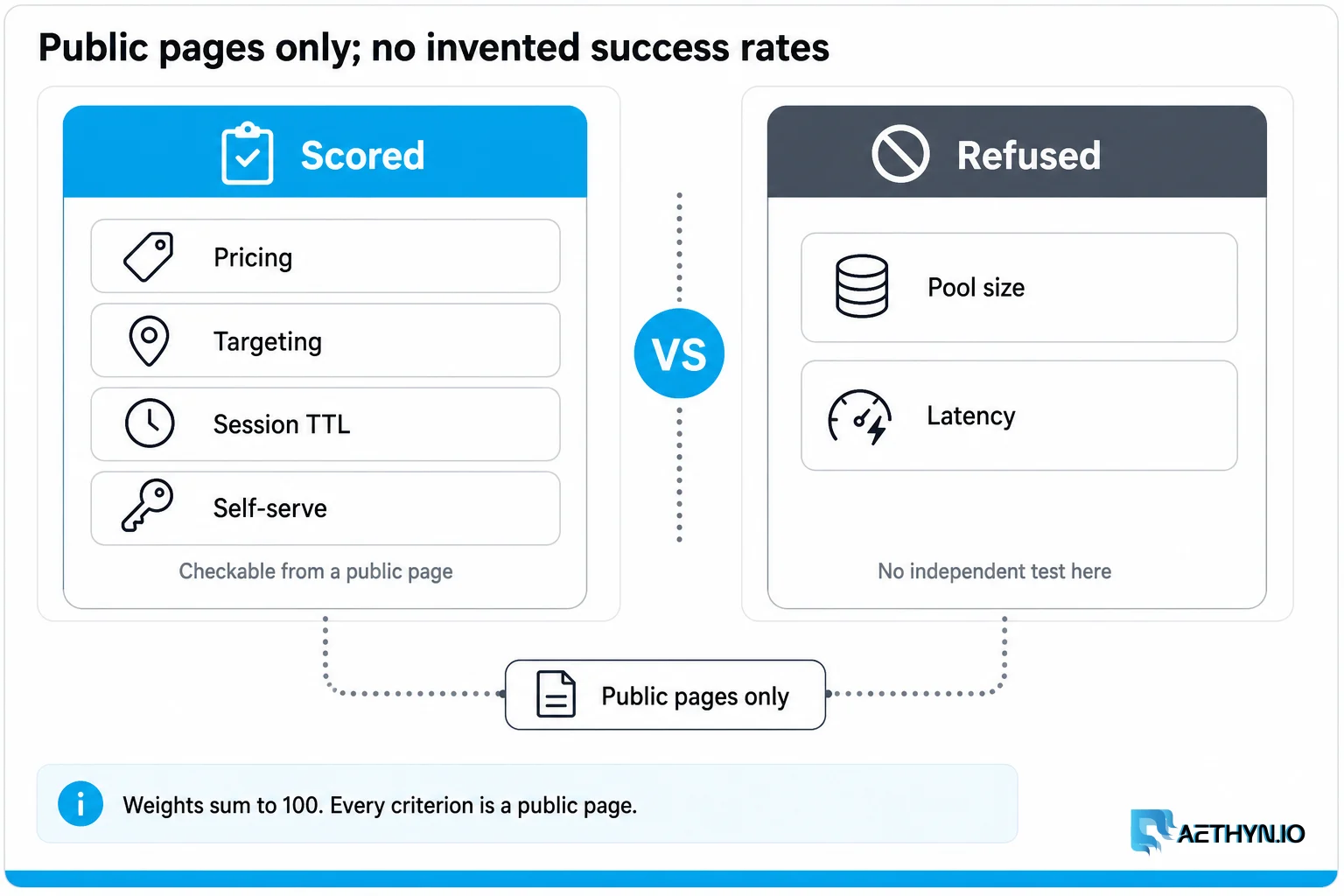
These scores measure documented / publicly available product characteristics (pricing pages, docs, signup paths) — not overall proxy quality, reliability, or performance.
| Criterion | Weight | What it measures |
|---|---|---|
| Pricing transparency | 20 | Per-GB or per-IP rate on a public page without a sales call |
| Entry commitment | 15 | Minimum spend or plan to get a working credential |
| Targeting granularity documented | 20 | Country / city / ISP / state / ZIP in their own docs |
| Session control documented | 15 | Sticky support and stated TTL range |
| Self-serve availability | 10 | Sign up, pay, get credentials without sales |
| Trial or refund policy published | 10 | Published trial terms or refund policy |
| Protocol + integration surface | 10 | HTTP/SOCKS5 and documented SDK/API |
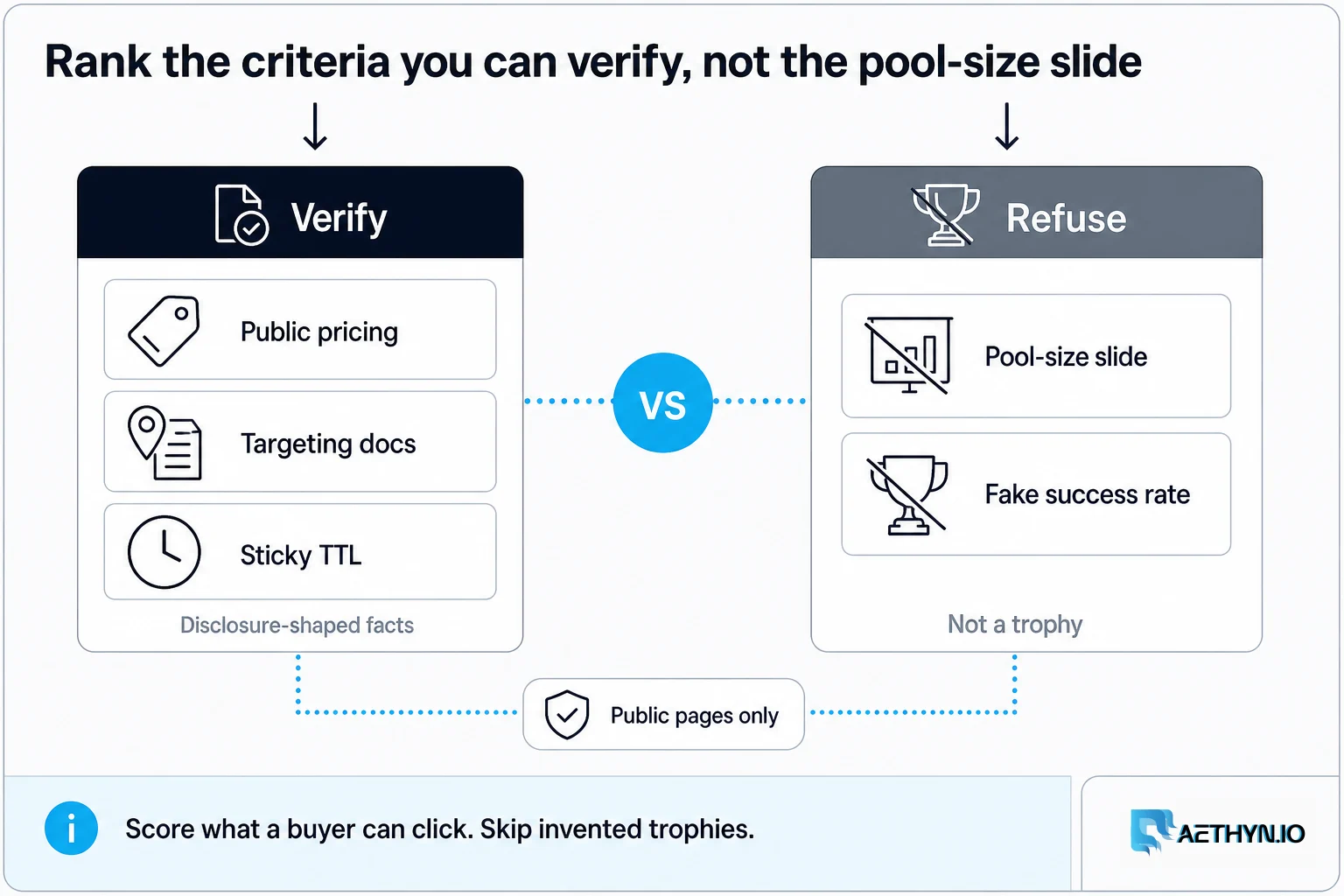
We do not rank on success rate, latency, or pool size, because this article does not include a sufficiently documented independent test for those metrics. Vendor IP counts, where mentioned elsewhere, are attribution only and are not scored here.
The comparison table above uses: Pricing Yes=20 / Partial=10; Entry Low=15 / Mid=10 / Sales=5; Targeting Full=20 / Country+city=14 / Unclear=8; Session+TTL=15 / Sticky unclear TTL=10; Self-serve Yes=10 / Partial=5; Trial/refund=10 / Unclear=4; Protocols+docs=10 / Partial=6.
Who We Included, and Who We Left Out
Inclusion: residential product line, self-serve signup for an entry plan, and a published pricing page (retrieved 2026-08-10).
Excluded: free proxy lists (sibling post); NetNut — excluded from this ranking because its current availability and network status could not be verified against this guide’s inclusion criteria as of the retrieval date; PacketStream-style P2P-only offers.
Provider Reviews
Our #1 pick in this guide
1. Aethyn
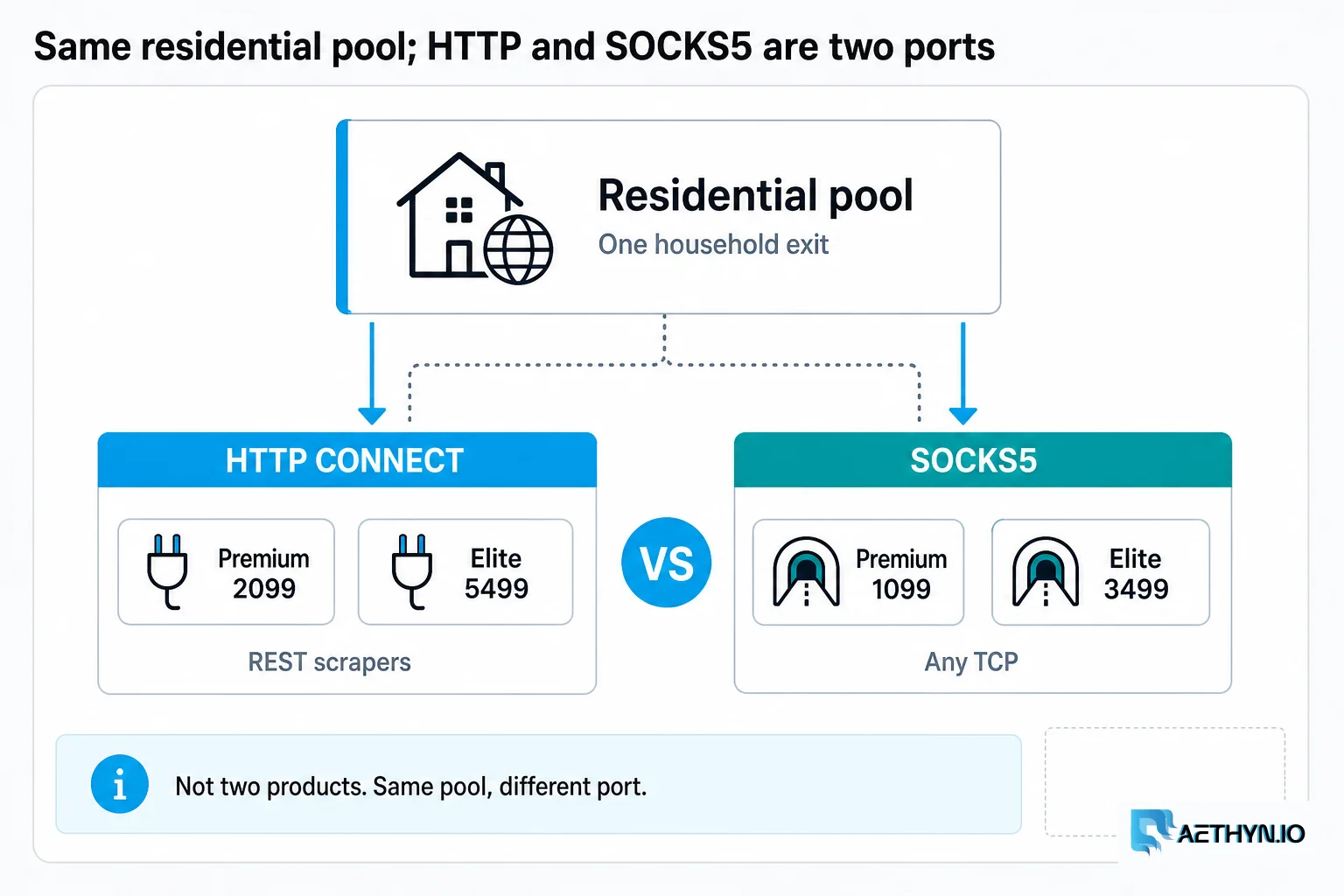
Aethyn sells residential proxies only — Premium and Elite — on proxy.aethyn.io with dedicated ports: Premium HTTP 2099 / SOCKS5 1099, Elite HTTP 5499 / SOCKS5 3499. Targeting uses username suffixes (country, city, ISP, state, ZIP). Sessions rotate by default or stick for 1–1440 minutes. Published pricing: €2.90/GB at entry volumes, from €2.00/GB at 90 GB+, €29 Starter for 10 GB/month Premium.
Best for: buyers who need city- and ISP-level residential targeting self-serve, at a published per-GB price, without an enterprise contract.
Pros
Cons
Source: According to Aethyn’s published pages — pricing, docs/targeting, and docs/protocols — retrieved 2026-08-10.
2. Bright Data
According to Bright Data’s published documentation, the catalogue covers residential, datacenter, ISP, mobile, and managed collection, with extensive public docs. Pricing and onboarding pages describe enterprise and sales-assisted options alongside self-serve surfaces.
Best for: enterprise buyers looking for a broad published proxy product catalogue and sales-assisted procurement.
Pros
Cons
Source: According to the provider’s published pricing page, retrieved 2026-08-10. Also: Aethyn vs Bright Data.
3. Oxylabs
According to Oxylabs’ published documentation, residential products are documented for enterprise programmes, with named-account sales and MSA-oriented procurement paths. Sticky sessions and geo parameters appear in their docs.
Best for: enterprise buyers looking for an account team and MSA-style procurement.
Pros
Cons
Source: According to the provider’s published pricing page, retrieved 2026-08-10. Also: Aethyn vs Oxylabs.
4. Decodo (formerly Smartproxy)
According to Decodo’s published pages (formerly Smartproxy), mid-market residential plans, a self-serve dashboard, and targeting docs are listed. Confirm live branding before updating runbooks — some public materials may still reference the prior name.
Best for: mid-market teams looking for a self-serve dashboard with published residential tiers.
Pros
Cons
Source: According to the provider’s published residential proxies page, retrieved 2026-08-10. Also: Aethyn vs Smartproxy (Decodo).
5. IPRoyal
According to IPRoyal’s published pricing pages, residential per-GB rates are listed and the site states no monthly minimum. Sticky session controls are documented. Published entry price is a starting point for your own pilot — this guide does not score quality from price alone.
Best for: buyers comparing providers on published low entry price.
Pros
Cons
Source: According to the provider’s published pricing page, retrieved 2026-08-10. Also: Aethyn vs IPRoyal.
6. Webshare
According to Webshare’s published pages, a free tier and low-cost paid plans are listed with API-oriented self-serve signup. Confirm whether an endpoint is datacenter or residential before production use.
Best for: developers starting from a free or low-cost published tier.
Pros
Cons
Source: According to the provider’s published residential page, retrieved 2026-08-10. Also: Aethyn vs Webshare.
7. SOAX
According to SOAX’s published documentation, residential and mobile products include geo controls and a managed dashboard. Narrow filters can reduce available exits per request — plan bandwidth when pinning rare cities or ISPs.
Best for: teams looking for granular geo controls with a managed dashboard.
Pros
Cons
Source: According to the provider’s published pricing page, retrieved 2026-08-10. Also: Aethyn vs SOAX.
8. Rayobyte
According to Rayobyte’s published pages, residential products and documentation on sourcing and compliance posture are listed. This guide reports that the documentation is published; it does not independently audit sourcing claims. Confirm your country list against their live geo docs.
Best for: buyers who want published sourcing and compliance documentation on file.
Pros
Cons
Source: According to the provider’s published residential proxies page, retrieved 2026-08-10. Also: Aethyn vs Rayobyte.
9. ProxyScrape
According to ProxyScrape’s published pages, low-cost residential and datacenter tiers are listed with self-serve access. Paid residential is a different product from free lists — keep credentials and expectations separate.
Best for: budget or high-volume buyers comparing published low-cost residential tiers.
Pros
Cons
Source: According to the provider’s published residential proxies page, retrieved 2026-08-10. Also: Aethyn vs ProxyScrape.
Where Aethyn Is Not the Right Choice
- Datacenter proxies — Best Datacenter Proxy Providers (2026). Aethyn does not sell datacenter IPs; providers that publish datacenter lines may fit that requirement better.
- Static / ISP sticky as a product line — Aethyn offers rotating residential and sticky TTL (1–1440 min), not a sold-as-static ISP product line. Bright Data, Oxylabs, and others publish dedicated ISP products — compare against those docs if that is your requirement.
- Mobile / 4G / 5G — Aethyn does not sell mobile. SOAX and Bright Data publish mobile lines on their sites.
- MSA + named account team — Bright Data or Oxylabs publish enterprise procurement paths that match this requirement more closely.
- Lowest published entry pricing — IPRoyal, Webshare, and ProxyScrape publish lower entry shapes than Aethyn’s €2.90/GB entry / €29 minimum (as of the retrieval dates above).
How to Run a Two-Vendor Pilot in a Week
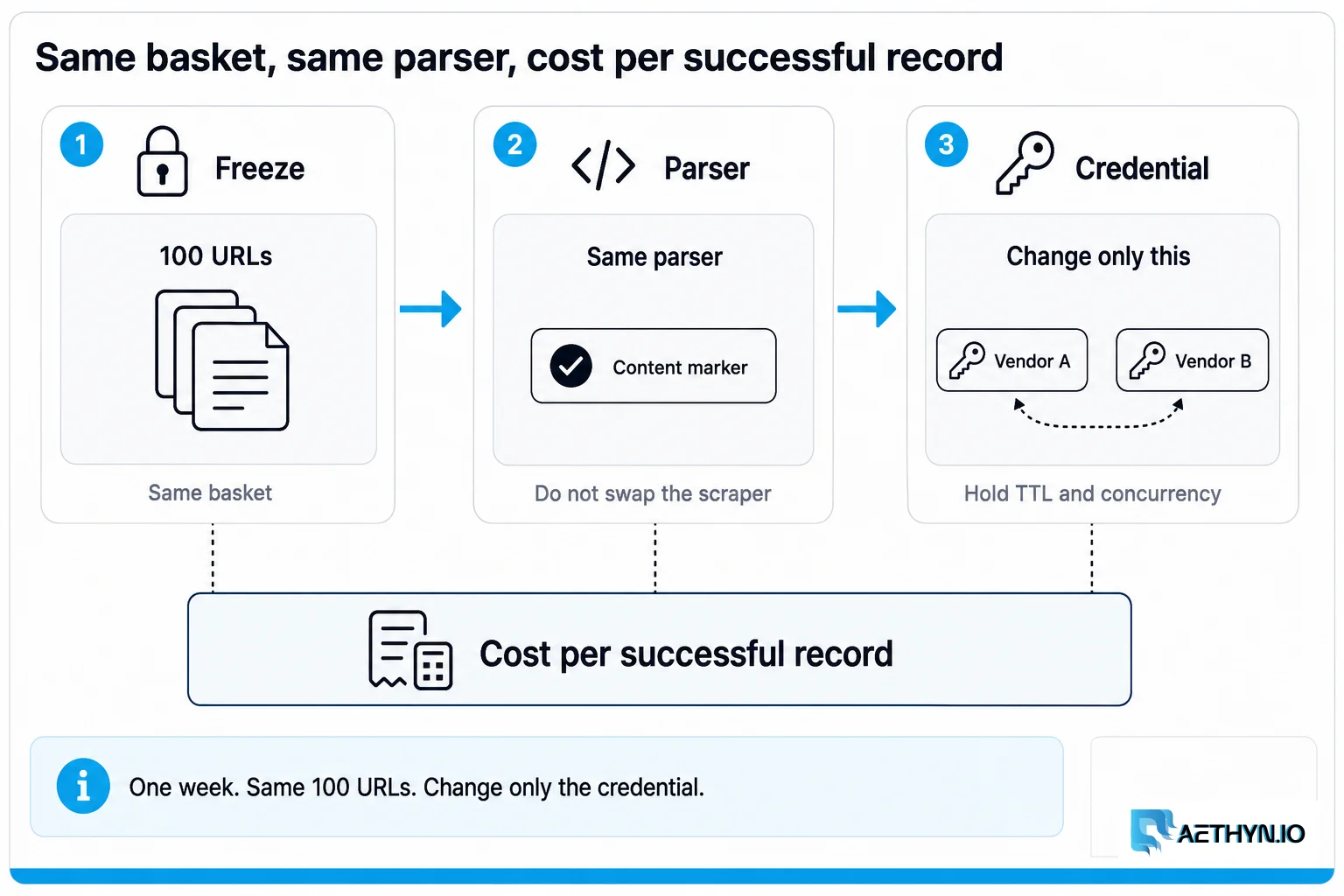
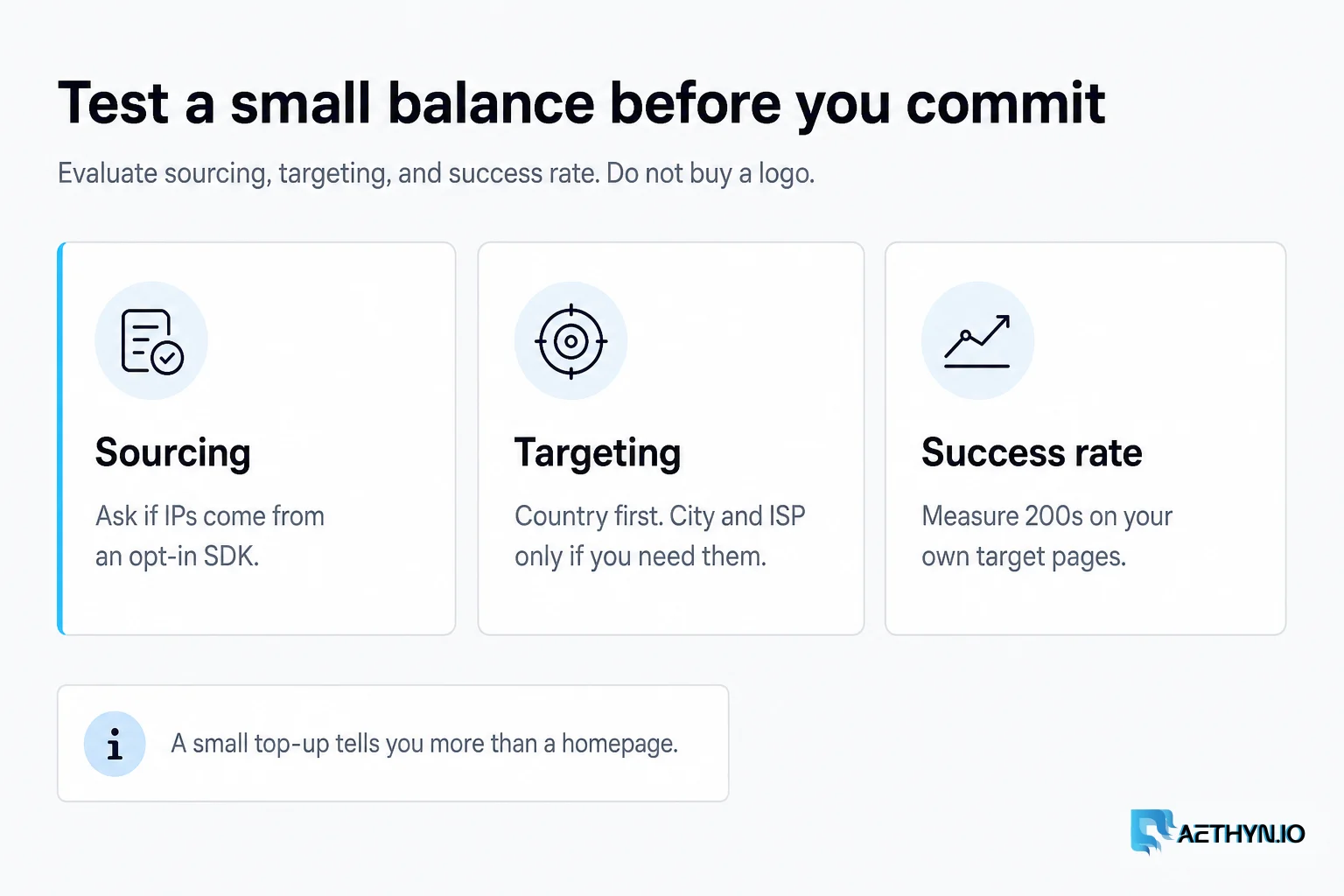
Freeze a 100-URL basket, use the same parser (assert a content marker), hold concurrency/headers/TTL constant, change only the credential, and log cost per successful record. Repeat three weekdays. Session semantics: Rotating vs Static Residential Proxies.
Session Control: What to Ask a Vendor Before You Pay
Ask for documented answers: sticky support and stated TTL range; rotation triggers; session-ID location; concurrent limits; remote DNS for SOCKS5 geo. If docs omit TTL, treat sticky behaviour as undefined for production logins.
Geo Granularity: Country, City, ISP
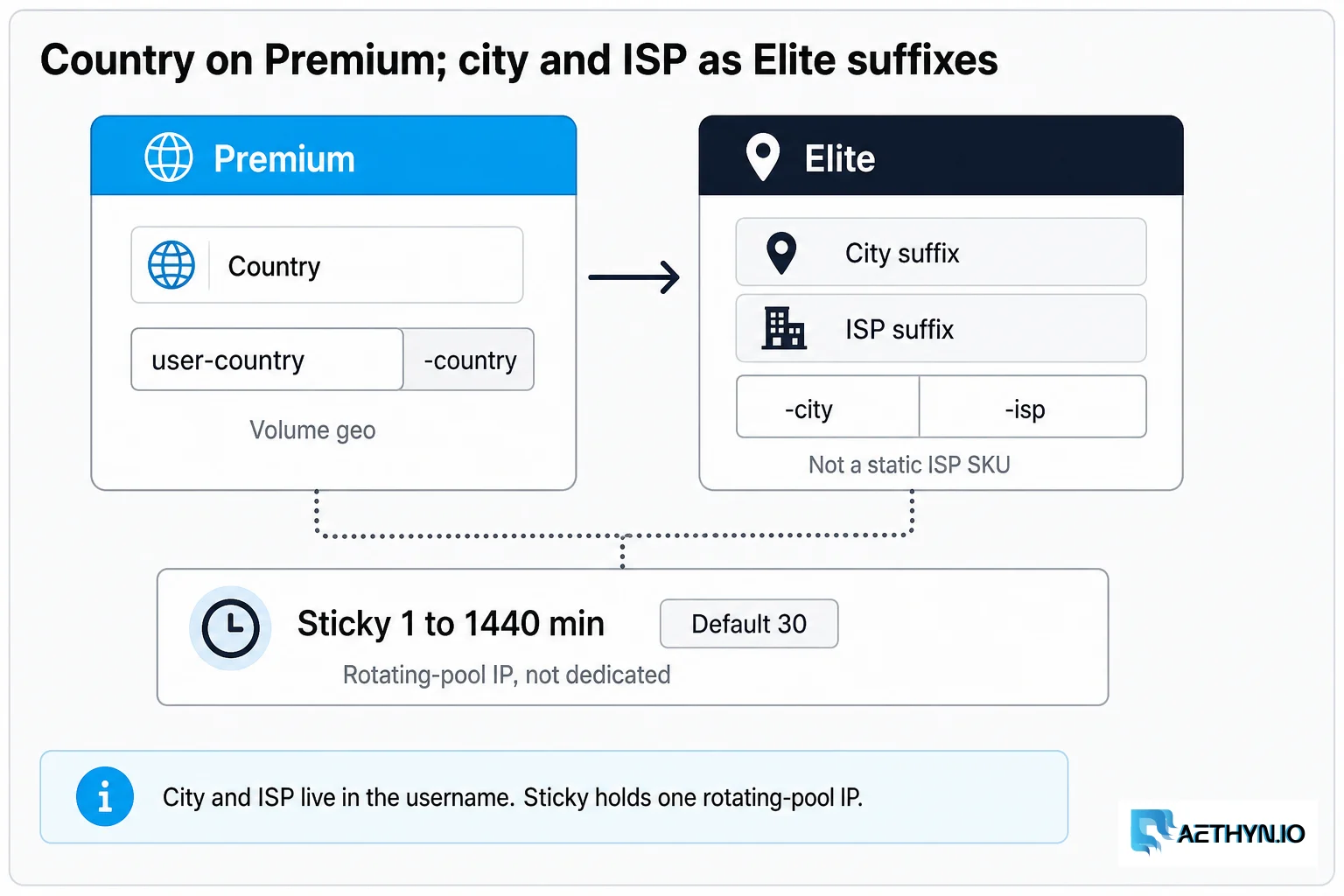
Country lives on Premium. City and ISP are Elite username suffixes — not a static ISP SKU. Sticky holds one rotating-pool IP for 1–1440 minutes (default 30).
| Vendor | What they document (verify live) |
|---|---|
| Aethyn | Country, city, ISP, state, ZIP username suffixes — self-serve (targeting, locations, SDK) |
| Bright Data | Country, city, ASN/ISP filters in product docs |
| Oxylabs | Country, city, ASN parameters in residential docs |
| Decodo | Country/city and dashboard targeting docs |
| IPRoyal | Country/city targeting on residential plans |
| Webshare | Geo options by plan — confirm residential vs DC |
| SOAX | Granular geo filters for residential/mobile |
| Rayobyte | Geo targeting documented — confirm country list |
| ProxyScrape | Geo options by product — confirm tier |
How-to: City-Level Residential Proxies & ISP Targeting.
Decision Matrix by Buyer Type
| Buyer profile | Recommended vendor | Why |
|---|---|---|
| City/ISP targeting self-serve at published €/GB | Aethyn | Fine geo + public ladder; no MSA |
| MSA, CSM, multi-product platform | Bright Data or Oxylabs | Enterprise catalogue and procurement |
| Mid-market dashboard, no enterprise sales | Decodo (formerly Smartproxy) | Published tiers + self-serve UX |
| Lowest published entry / no monthly minimum | IPRoyal or ProxyScrape | Public low-entry residential pages |
| Free tier to prove a parser in CI | Webshare | Published free + paid ladder |
| Mobile exits required | SOAX or Bright Data | Publish mobile lines (Aethyn does not) |
| US-centric + sourcing docs on file | Rayobyte | Publishes sourcing/compliance pages |
| Amazon marketplace collection | See Amazon proxies | Target-level workflow, not this vendor table |
| Social account automation | See social proxies ranking | Use-case ranking, not this vendor table |
Common questions about residential proxies for scraping
What makes a residential proxy good for web scraping?
Does Aethyn sell datacenter, static ISP, or mobile proxies?
What ports does Aethyn use for HTTP and SOCKS5?
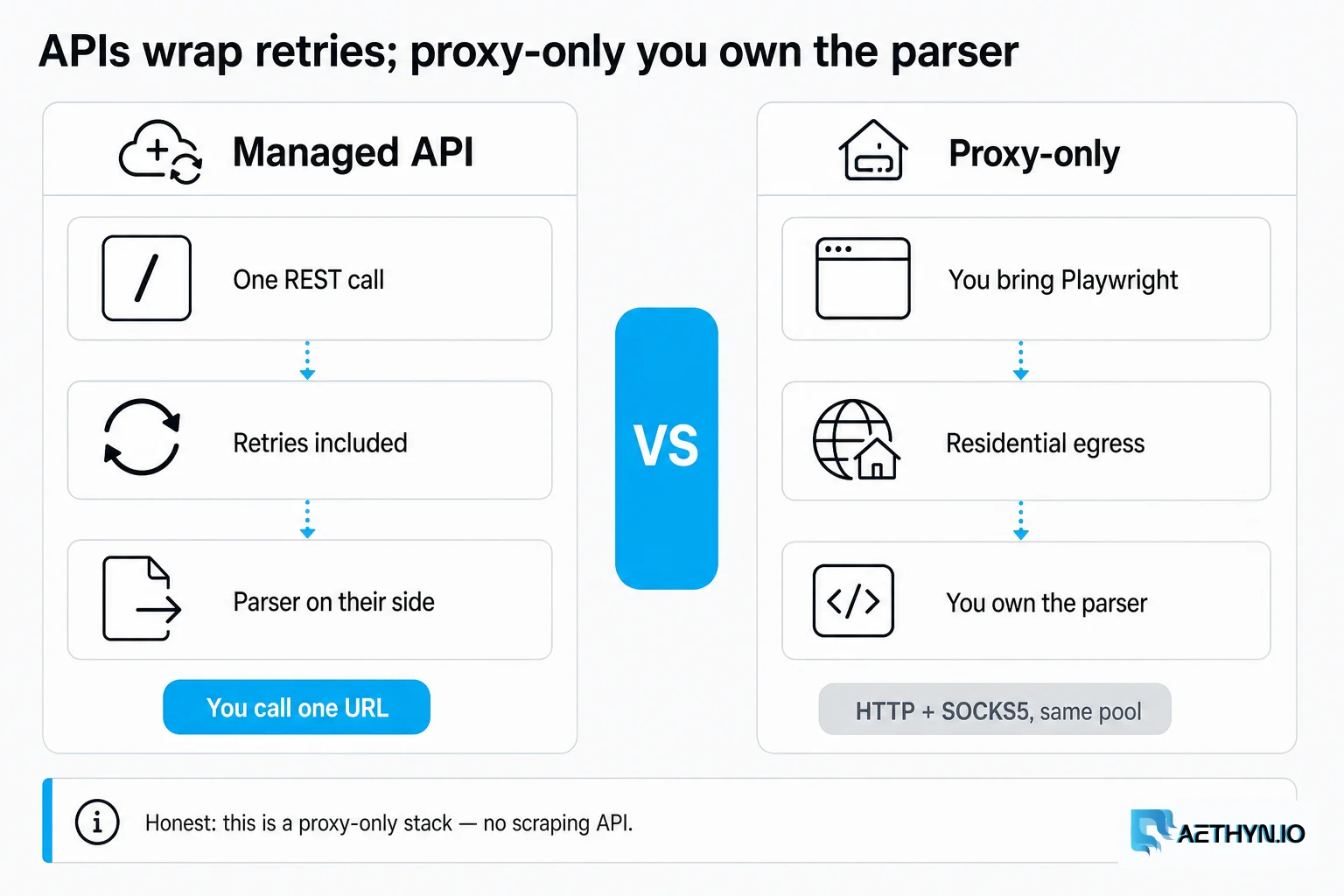
Should I buy a scraping API instead of residential proxies?
Why is NetNut excluded from this ranking?
How should I compare two residential vendors before committing?
Where can I find a vendor-agnostic proxy buying checklist?
Guides, integrations & docs
Continue reading
How to Choose the Best Proxy Provider (Checklist)
Don't waste money on unreliable IPs. Use our 10-point checklist to evaluate any proxy provider before you buy.
ScraperAPI vs Proxy-Only: Web Scraping API Comparison (2026)
ScraperAPI and ZenRows bundle proxies with rendering and retries. Aethyn and Bright Data sell raw proxies. We compare cost, control, and maintenance for engineering teams in 2026.
Best SOCKS5 Proxy Providers in 2026 (Comparison)
SOCKS5 proxies power scrapers, bots, and tunnel tools that do not speak HTTP CONNECT. We ranked 10 providers on protocol support, residential reputation, and pricing for 2026.
Ready to test on your stack?